
Home JewishPro

Powered by M²

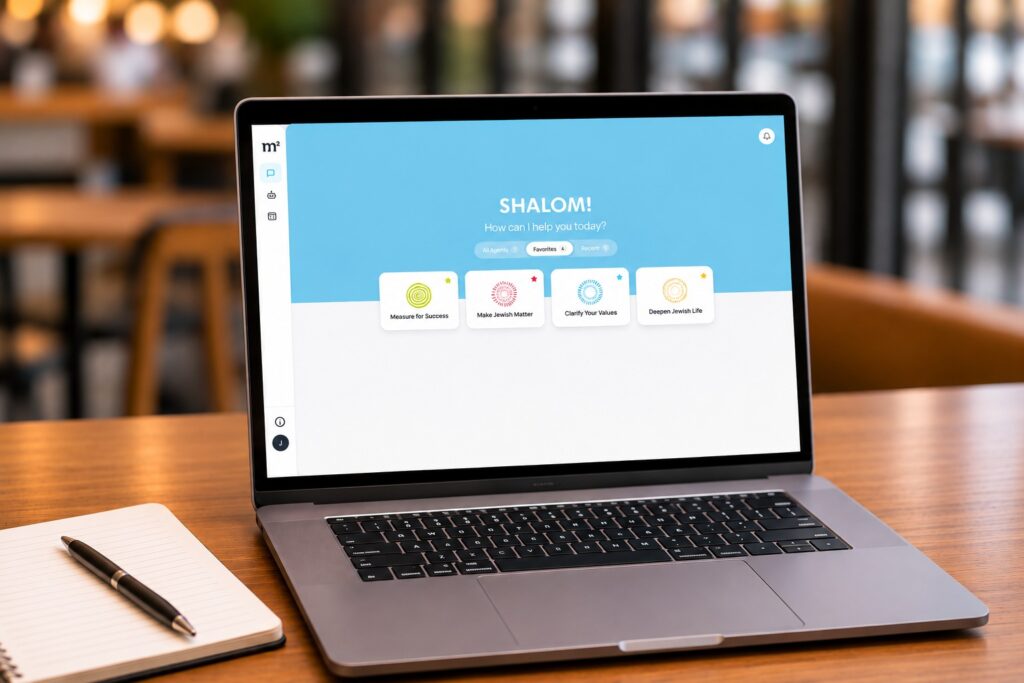
Introducing JewishPro

Your AI-powered thought partner

Meet JewishPro, your AI-powered thought partner for meaningful work and thoughtful Jewish experiences.

From a spark of inspiration to a ready-to-use program, JewishPro helps you clarify your goals, explore Jewish content, and bring your vision and your values to life.

Not just answers.
Better questions.

AI is changing how professionals plan and design, and execute their work. Meaningful Jewish work requires more than generating content.

JewishPro brings together the possibilities of AI with the depth of Jewish wisdom and M²’s approach to values-based work and education.

It helps you fully think through your ideas and make intentional choices, so that you can create experiences that resonate and focus on what really matters.

what makes JewishPro unique

Key features and values:

Think with purpose

Work with AI like a chevruta — a thinking partner that asks thoughtful questions, sharpens your ideas, and draws out your vision and expertise. JewishPro helps you bring greater depth and intention to your work.

Design with confidence

Draw on curated Jewish sources, vetted translations, and workflows designed to minimize AI errors and prevent hallucinated sources. JewishPro helps you create materials grounded in your values and priorities.

Work with understanding

Bring your audience, purpose, and community into focus. Built for Jewish professionals and educators, JewishPro understands the language, traditions, and nuances that make your community and context unique.

Create with expertise

Turn your goals into usable outputs with specialized skills for Jewish professionals. Develop lesson plans, source sheets, facilitation guides, proposals, and evaluation tools—or draw insights from community studies—with confidence.

What JewishPro Does

From everyday challenges to meaningful Jewish impact, explore how JewishPro helps you think, plan, and create with purpose.

“I want to teach responsibility at camp. Help me move beyond a general message about helping others and create a program with real tensions our teens can wrestle with.”

Let’s first get clear on the value at the heart of this. That’s what will make whatever you produce feel specific rather than generic.

Two values come to mind:

  • Responsibility (אחריות): Camp gives teens real stakes, like a bunk, a younger camper, or a job they signed up for. It’s where “I’m answerable for this” can feel concrete instead of abstract.
  • Mutual responsibility (ערבות): A camp is a kehillah, and this version asks what teens owe each other and the group. It moves the focus from “I help” to “I’m accountable to and for us.”

Which feels closer to what you want your teens to wrestle with? Or is it something else entirely?

“I'm planning a session on Jewish peoplehood for college students. Help me clarify what I want them to explore and design an experience that invites genuine participation.”

Let's work out which part of peoplehood you want them to explore. It's a big idea, and a session that tries to cover all of it usually stays at the level of "we're all connected."

Here are three ways people understand peoplehood. See which one pulls at you.

1. Shared story and fate. Jews are bound by a common history, memory and destiny, so what happens to Jews anywhere touches Jews everywhere.
2. Mutual responsibility. Being part of the people means you owe something to other Jews, and they owe something to you, even when you disagree or don't like each other.
3. Belonging across differences. The Jewish People is a family that holds many different kinds of Jews: observant and secular, Israeli and diaspora, Ashkenazi, Sephardi, Mizrahi, Jews of color, interfaith families.

Tell me whether one of the three lenses fits, or whether you see it differently.

“Our foundation wants to support Jewish connections among young adults. Help us clarify the change we want to fund and develop a call for proposals that communicates it.”

Before we get into writing the actual call for proposals, it helps to get clear on exactly what kind of change you’re going for. Are you hoping to have them feel more connected to each other? To the larger Jewish community? To your foundation specifically? To Israel?

That’s what makes the RFP precise and rooted. Want to work through that together, or would you rather jump straight to drafting a general call for proposals based on what we have?

“Our board and staff have different views about our Jewish priorities. Help me plan a conversation that surfaces those differences and builds clearer shared direction.”

Here are three ways to run the conversation:

  1. Private input first, then a shared meeting. Board and staff each answer the same questions on their own, and you bring the results into the room. This fits best if you suspect people are softening their views in front of each other.
  2. One mixed-room working session. Board and staff sit together and sort a set of candidate priorities into “must,” “important,” and “not now.” The disagreements show up in the sorting. This is the fastest route, but it’s harder if there are power dynamics.
  3. Tension-led dialogue. You name two or three real trade-offs and each group argues for what it would give up. This is the most honest option, and needs a strong facilitator.

My recommendation is to start with option 1 and follow it with a short version of option 3. The private input shows you where the differences really are. The dialogue then focuses on the few that matter.

Be Part of What’s Next

Interested in experiencing JewishPro?

Share your details to hear about early-access opportunities and product updates.

Let’s build something together

Interested in bringing your content to JewishPro?

Partner with us to share your resources with Jewish professionals and educators around the world.

Be Part of What’s Next

Interested in experiencing JewishPro?

Share your details to hear about early-access opportunities and product updates.

The JewishPro Team

David Wietchner

Director of AI Research and Content

The Strategist

“The most powerful tool is a well-defined will.”

David

Wietchner

Director of AI Research and Content

The Strategist

“The most powerful tool is a well-defined will.”

Hyim Brandes

Director of JewishPro

The Architect

“The future begins with the courage to design it.”

Hyim

Brandes

Director of JewishPro

The Architect

“The future begins with the courage to design it.”

Justin Rockman

General Manager, Products & Technologies

The Architect

"The best way to create the future is to design it”

Justin

Rockman

General Manager, Products & Technologies

The Architect

"The best way to create the future is to design it”

Our Supporters

Lorem ipsum dolor sit amet, est ne suas iriure, cu eripuit copiosae sensibus qui, mel te labores docendi. No qui essent copiosae singulis, pro et probo graeco oblique, albucius dissentiet instructior eu has. Mei iuvaret gubergren te, his quando invidunt deterruisset in, at vel convenire patrioque. No nisl voluptaria instructior sed, quaeque maluisset at ius. Et fabulas officiis pro, eos no commodo sapientem interesset.

Use JewishPro for…

“I want to create a program that strengthens Jewish identity.”

JewishPro ASKS

What kind of identity?
For whom?
What would change look like?

Lorum ipsum

Lorem ipsum dolor sit amet, consectetur adipiscing elit.

dapibus leo.

Ut elit tellus, luctus nec ullamcorper mattis, pulvinar dapibus leo.

eum te dolore fabulas scripserit

Mel placerat prodesset

Id dolore ornatus volutpat sea,

Outcome Statements

Clear outcomes tied to your audience

Program Designs

From goals to usable program outlines

Evaluation Tools

Surveys and guidance for interpreting results

Testable Indicators

Concrete definitions of success

Facilitation Guides

Drawing on vetted Jewish content

Portfolio Insights

Patterns across aggregate information

WHAT CAN YOU CREATE?

Tools and materials you can put to work: