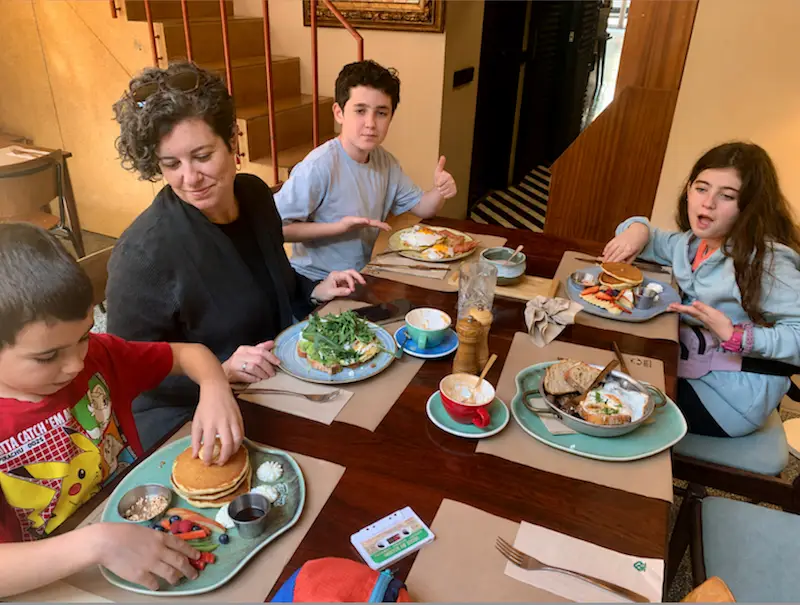
Before having my own family, I pictured an idyllic Shabbat table where we would discuss the week’s Torah portion, parshat hashavua. My hypothetical children would ask the deepest questions about ethical issues after learning about the Israelites’ journey through the desert or Joseph’s dreams.
My real family, however, is not this. Friday nights in our house are mostly pure chaos. No matter when Shabbat starts, we are always rushing to get dinner ready. The kids, now ages 13, 11, and 8, are always starving, and fights break out over who sits where, who got more grape juice, and which one sets the table more often than the others. Why is it always him? Is he the only one who truly cares about eating?? Why are things so unfair??
Once we’re eating, we usually settle into a groove, and we have our Shabbat dinner routines, but talking about parshat hashavua has not made the cut.
When I started writing Crossroads Cards at M², I began bringing the dilemmas home to try out with my kids. The Shabbat Discussions Edition is a deck of conversation cards, one for each week’s parsha.
Each card has a dilemma that a kid might face. And all of the dilemmas were tested with my very own children (and my cousin’s children, and my friends’ children, and many people who happened to spend Shabbat meals with us over the last few months). I would read a card, and my kids would offer me their unvarnished opinions. “No one would ever say that!” one might scold. Or, “YES. That happens in my class ALL THE TIME!” Sometimes they would offer tweaks: “No one would care about this thing; change it to that thing, but the situation works.” And they were always excited to tell me what they would do in any particular dilemma. More often than not, I took their notes. The cards that made it into the final version are the ones that survived their scrutiny.
I know my kids, and I could often guess how they would react to a dilemma. One of them almost always chose to speak up, call someone out, or make a change, while the other almost always chose to keep her head down, move on, and not rock the boat. What I started to be able to name for my kids, as we worked on both creating and then discussing these dilemmas, was that each of them often prioritizes particular but differing values. I was able to name for my 11-year-old that she often leans toward the value of independence, while my 13-year-old prioritizes community and integrity, and my 8-year-old leans toward peace. My kids are proud to look at real-life decision-making and connect it to a value, and they are even willing to flip the card over and connect their ideas to the parsha.
At long last, we have found a way in.

Ilana Gleicher-Bloom is the Director of Resources at M². She’s hosting an upcoming webinar on How to Use the Shabbat Crossroads Cards on Tuesday, September 2nd. Don’t miss it!
This is the third in an occasional series of personal essays by M² staff members.