
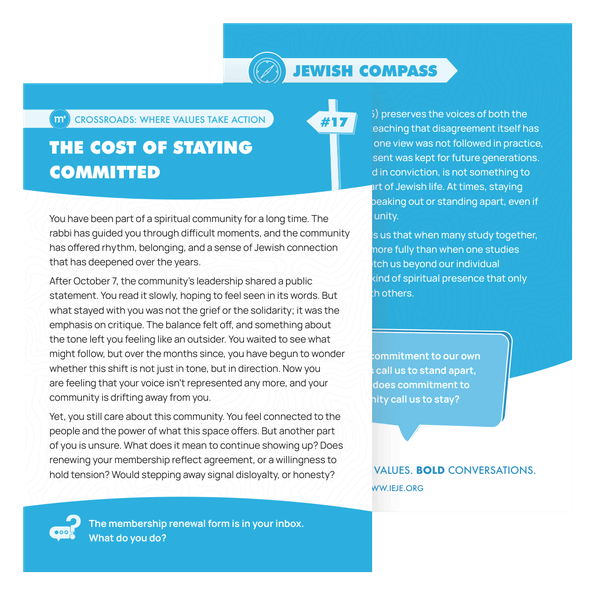
The Cost of Staying Committed
You have been part of a spiritual community for a long time. The rabbi has guided you through difficult moments, and the community has offered rhythm, belonging, and a sense of Jewish connection that has deepened over the years.
After October 7, the community’s leadership shared a public statement. You read it slowly, hoping to feel seen in its words. But what stayed with you was not the grief or the solidarity; it was the emphasis on critique. The balance felt off, and something about the tone left you feeling like an outsider. You waited to see what might follow, but over the months since, you have begun to wonder whether this shift is not just in tone, but in direction. Now you are feeling that your voice isn’t represented any more, and your community is drifting away from you.
Yet, you still care about this community. You feel connected to the people and the power of what this space offers. But another part of you is unsure. What does it mean to continue showing up? Does renewing your membership reflect agreement, or a willingness to hold tension? Would stepping away signal disloyalty, or honesty?
The membership renewal form is in your inbox. What do you do?
Jewish Compass
The Mishnah in Eduyot (5:6) preserves the voices of both the majority and the minority, teaching that disagreement itself has enduring value. Even when one view was not followed in practice, the record of principled dissent was kept for future generations. Disagreement, when rooted in conviction, is not something to suppress but an integral part of Jewish life. At times, staying true to principle requires speaking out or standing apart, even if it risks breaking communal unity.
Yet Pirkei Avot (3:7) reminds us that when many study together, the Divine Presence rests more fully than when one studies alone. Community can stretch us beyond our individual perspectives, offering the kind of spiritual presence that only emerges in relationship with others.
When does commitment to our own convictions call us to stand apart, and when does commitment to community call us to stay?