“A counselor’s job is to give advice. True or False?”
That was the question my professor posed on my first day of graduate school for mental health counseling. If I’m being honest, I wasn’t sure what to think, but the correct answer was “false.”
While I still think the question is debatable, what I learned that day has stuck with me ever since: The role of a counselor is to serve as a mirror. Doing so empowers our clients to discover the strengths and capabilities that already lie within themselves.
That insight uncovered a truth I’ve held onto ever since: Introspection is the most powerful tool any of us have.
I made a conscious choice early in my career to shift from therapeutic work to focusing on human development in different, non-clinical settings: First in overnight camping and now at M², where I’ve been for five years so far. As my career has evolved, I’ve revisited this question frequently: How can introspection be a tool for provoking growth and development outside of the therapeutic environment? Over the years, I’ve developed a few responses, which feel particularly relevant in this Jewish season of introspection, as we approach Rosh Hashanah and consider the new year ahead.
As educators and facilitators, we put a provocative idea in front of our learners then create a container in which they wrestle with it to make sense of the idea. Introspection is educators’ super-charged power tool for developing our learners as reflexive practitioners.
Not reflective, but reflexive.
Consider what happens when you reflect back on something. It’s a moment in time that cannot be changed. It’s fixed. Reflexes, however, are dynamic. When the doctor bops your knee just in the right spot it forces a movement, a reflex, in your foot. As educators, introspection becomes our tool for provoking our learners to adopt practices by which they are dynamically integrating learnings as they carry themselves forward.
However, now that I’ve spent over 20 years observing the power of introspection, I can’t help but notice how frequently we tend to overlook its usefulness.
Rabbi Angela Buchdahl recently gave a beautiful sermon on the practice of what she called “resilient listening.” It highlighted how too often we stop listening when we hear something that rubs us the wrong way. In her eloquent and inspirational way, I appreciated how she put a spotlight on precisely the moments I’ve observed. When we stop listening is exactly the opportune moment to dig inward with curiosity and wonder. It’s that inward journey that enables us to uncover something new and where our greatest power is unleashed.
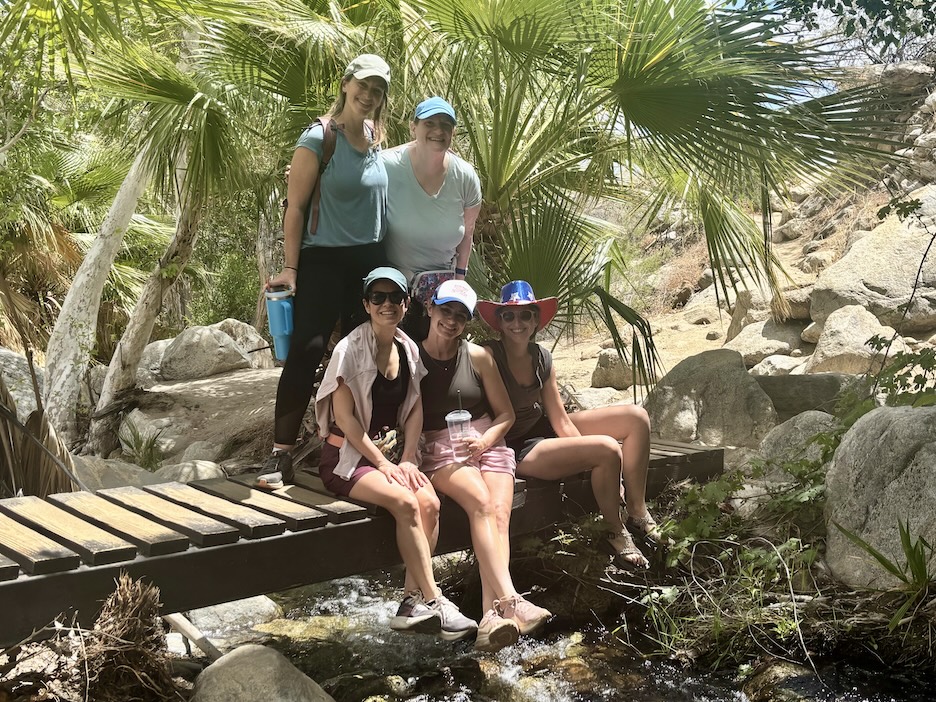
I reached a milestone birthday this year: 40. Leading up to it, I spent a fair amount of time self-assessing where I was in life and measuring how close or far off it was from where I imagined I would be at this stage. Then, about two months before my birthday, my attitude shifted toward a more pleasant version of introspection. It happened at a distinct moment around a fire pit with four of my dearest friends. We took a trip out to the California desert for our birthdays and filled the week with beautiful hikes, belly laughs, delicious food, and meaningful conversation. No partners, no kids, just us building off those summer camp friendships that took form 30+ years ago.
I recall the moment where everything around me paused for one brief moment and the internal “aha” bulb lit up: I could feel the warmth of the fire, gratitude for the shining stars above us and the peaceful environment. “If this is 40,” I thought, “I am so blessed, and life is so good.” For that genuine contentment to have settled in, I had to first really go through the not-so-comfortable process of questioning, wondering, and inner challenging.
As I departed that vacation and reintegrated to day-to-day life back home it became my mantra to consciously lean into this next chapter with that same degree of contentment.
So, with Rosh Hashanah around the corner, our Jewish calling to introspect is here. The beautiful thing about this holiday, though, is that we’re all in it together. There’s a synergy in our collective gathering, where vulnerability is energetically felt, grace is extended with greater ease, and the deepest forms of connection—to ourselves, to one other, to our past and future—is nurtured.
And when it gets uncomfortable, my hope for each of us this Rosh Hashanah is that we’ll stick with the process long enough to reach the peaceful side of it. That we’ll cultivate greater awareness of when looking within might provide just the power and resilience we need, and that we’ll bring insights we develop that enable us to bridge that gap between who we are and who we wish to be (individually, communally, as a people or nation) as reflexive practitioners to our everyday spaces, even when life is challenging or the world feels overwhelming.
Wishing each of you and your loved ones a meaningful High Holiday season and an empowering start to this new year. Shana tova!
Abby Mintz is a Senior Program Director at M².
This is the latest in our series of personal reflections by M² staff members.