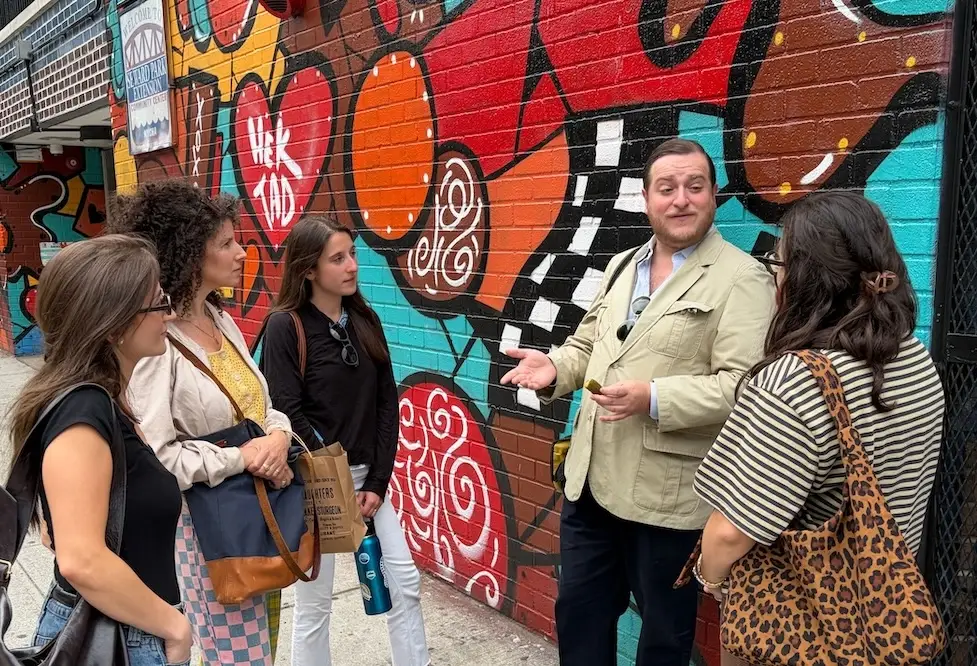
As the United States prepares to celebrate its 250th anniversary, we on M²’s New York-based team spent a recent afternoon exploring the Jewish history of Manhattan’s Lower East Side neighborhood.
I was particularly excited for this activity, because my maternal grandfather grew up on the Lower East Side. I was raised on stories of him and his five brothers playing box ball on the neighborhood’s sidewalks—a game we’d play together outside my childhood home—and getting pickles from the barrels at Guss’ Pickles. Our family would come once or twice a year for dinner at the now-closed Ratner’s restaurant on Delancey Street, a neighborhood institution.
All this to say, a Jewish history walking tour of the Lower East Side with a knowledgeable and passionate tour guide and my thoughtful, engaging colleagues is very much my jam.
But first… lunch (which is also my jam).
Before our tour, we dined at Russ & Daughters, a storied neighborhood restaurant offering bagels, lox, and other smoked fish – what my grandparents called “appetizing”—alongside various other traditional Ashkenazi Jewish dishes (think potato latkes, borscht, and kasha varnishkes).
Then it was time to meet our tour guide, Dr. Yitzchak Schwartz, a historian and Jewish day school teacher. Yitz spent the next two hours bringing us back to the Jewish heyday of the Lower East Side, from the mid 1800s until soon after World War II, a remarkable period of growth and vibrancy for American Judaism. After munching on pickles Yitz provided from The Pickle Guys, the last shop of its kind, we learned that some huge percentage of Jewish immigrants to the U.S. during that time lived for at least a period in this neighborhood, just as my grandfather’s family did. In fact, he said, at least 50 percent of American Jews have some familial connection to the Lower East Side—the numbers were just that high. At its peak, the neighborhood, which back then encompassed a significantly larger geographic area, was home to half a million Jewish immigrants, along with over 100 synagogues (and 80 pickle places!).
Yitz described the neighborhood’s cramped tenement apartments, often with multiple families crowded into three-room units with few windows and little ventilation. The opening of the neighborhood’s very first park was cause for celebration, even as it heralded the rise of rents nearby. He described and pointed out the settlement houses, community centers that provided everything from English classes to food assistance, first to Jewish immigrants and continuing today, mostly to the Latino and Asian communities that live here now.
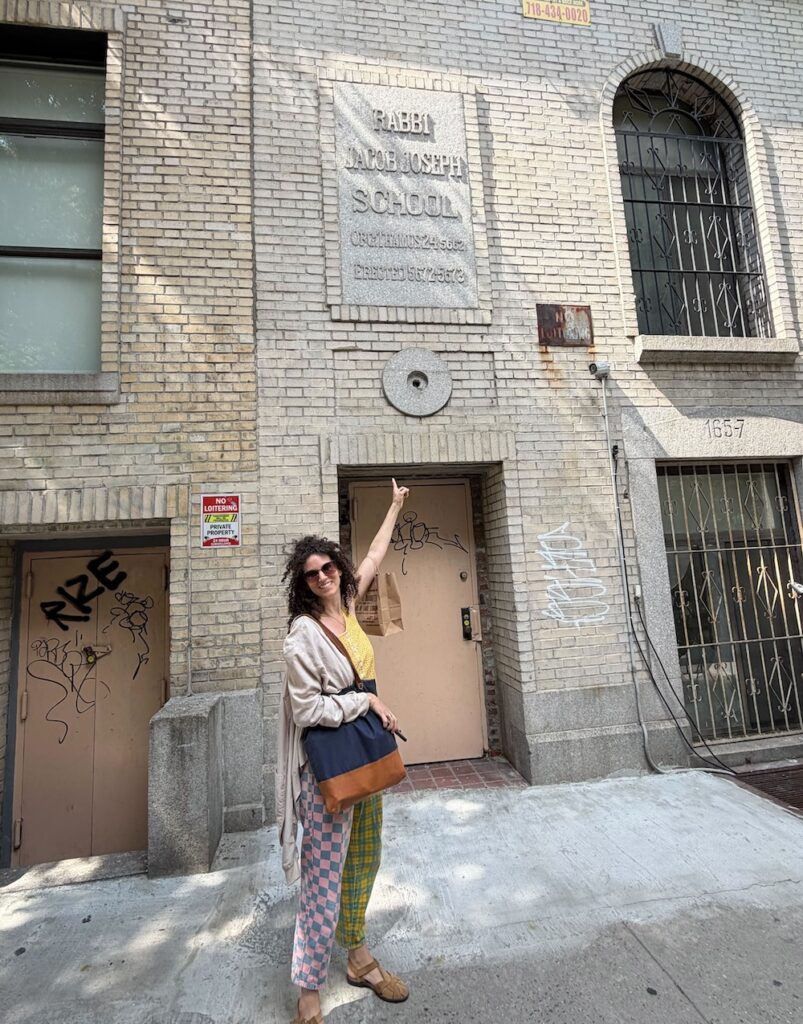
As we wandered streets whose names I remember from my grandfather’s stories—Essex, Grand, Henry—Yitz pointed out the buildings that once housed the institutions where American Judaism itself took shape. Now mostly high-end apartments, these were the spaces in which newly arrived Jews negotiated what it meant to be Jewish in America: The secular Jewish vision of the Yiddish Forward newspaper, carvings of major Socialist thinkers still adorning the façade of its longtime headquarters. The home-based synagogues of Shtiebel Row, nameplates hinting at the subtle and not-so-subtle differences between the worship styles of each congregation. The Jewish day-school model, offering traditional Judaic studies alongside modern secular curricula, pioneered by the Rabbi Jacob Joseph School, which we learned was founded by our colleague Mollie Andron’s great-great-grandfather. The site where the forerunner of Yeshiva University first sat, before moving far uptown to its current Washington Heights campus. And so on.
To me, the Lower East Side is as close to sacred ground as it gets for American Jews. Close your eyes and you can picture the pushcarts selling all sorts of wares, the throngs of people—our ancestors—shopping, praying, playing, striving to make a living, and figuring out, in their mix of Yiddish and English, what it means to be Jewish in their new home and how Judaism and America can thrive together.
Today, though some Jews remain, most left the Lower East Side long ago, just as my grandfather did as a young man many decades ago. But this Independence Day, as America turns 250, I am grateful for their legacy, their foresight, their commitment—and their cuisine.

Michael Kress is the VP of Marketing at M². This is the first in an occasional series of reflections by M² staff members.
If you are interested in arranging a tour of the Lower East Side—or exploring the Jewish history of virtually any New York City neighborhood—Dr. Yitzchak Schwartz is available at: (973) 951-9100.