
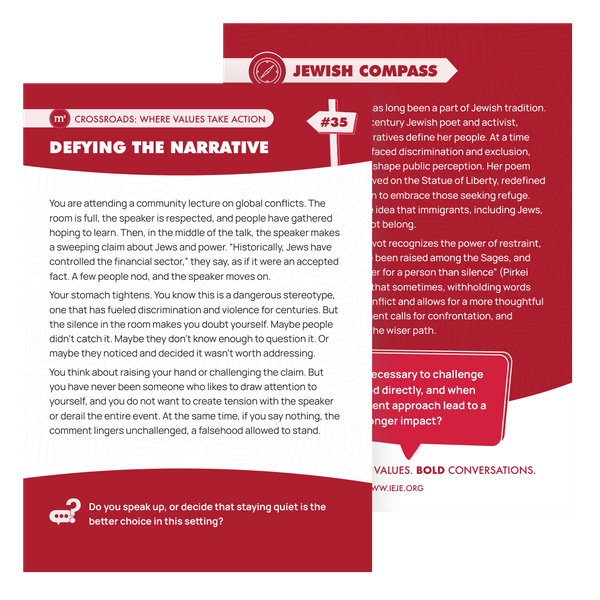
Defying the Narrative
You are attending a community lecture on global conflicts. The room is full, the speaker is respected, and people have gathered hoping to learn. Then, in the middle of the talk, the speaker makes a sweeping claim about Jews and power. “Historically, Jews have controlled the financial sector,” they say, as if it were an accepted fact. A few people nod, and the speaker moves on.
Your stomach tightens. You know this is a dangerous stereotype, one that has fueled discrimination and violence for centuries. But the silence in the room makes you doubt yourself. Maybe people didn’t catch it. Maybe they don’t know enough to question it. Or maybe they noticed and decided it wasn’t worth addressing.
You think about raising your hand or challenging the claim. But you have never been someone who likes to draw attention to yourself, and you do not want to create tension with the speaker or derail the entire event. At the same time, if you say nothing, the comment lingers unchallenged, a falsehood allowed to stand.
Do you join your friends in speaking up, or do you let the moment pass and move on?
Jewish Compass
Challenging falsehoods has long been a part of Jewish tradition. Emma Lazarus, the 19th-century Jewish poet and activist, refused to let harmful narratives define her people. At a time when Jewish immigrants faced discrimination and exclusion, she used her writing to reshape public perception. Her poem The New Colossus, engraved on the Statue of Liberty, redefined America’s moral obligation to embrace those seeking refuge. Her words challenged the idea that immigrants, including Jews, were outsiders who did not belong.
At the same time, Pirkei Avot recognizes the power of restraint, teaching “All my life I have been raised among the Sages, and I have found nothing better for a person than silence” (Pirkei Avot 1:17). This suggests that sometimes, withholding words prevents unnecessary conflict and allows for a more thoughtful response. Not every moment calls for confrontation, and silence can, at times, be the wiser path.
When is it necessary to challenge a falsehood directly, and when does a different approach lead to a stronger impact?