
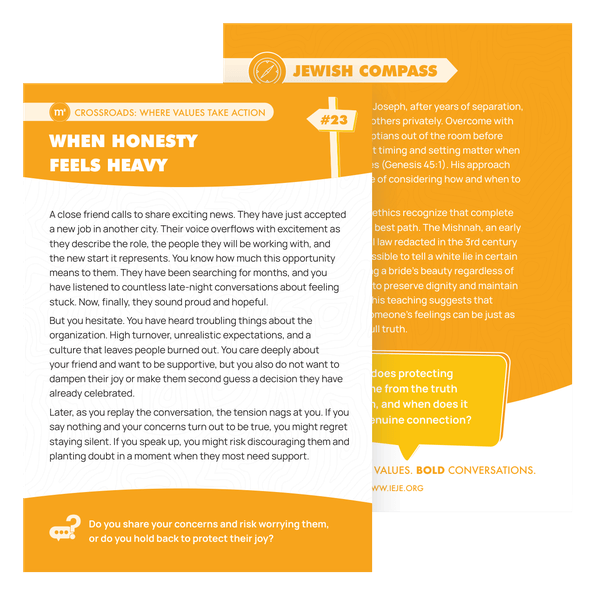
When Honesty Feels Heavy
A close friend calls to share exciting news. They have just accepted a new job in another city. Their voice overflows with excitement as they describe the role, the people they will be working with, and the new start it represents. You know how much this opportunity means to them. They have been searching for months, and you have listened to countless late-night conversations about feeling stuck. Now, finally, they sound proud and hopeful.
But you hesitate. You have heard troubling things about the organization. High turnover, unrealistic expectations, and a culture that leaves people burned out. You care deeply about your friend and want to be supportive, but you also do not want to dampen their joy or make them second guess a decision they have already celebrated.
Later, as you replay the conversation, the tension nags at you. If you say nothing and your concerns turn out to be true, you might regret staying silent. If you speak up, you might risk discouraging them and planting doubt in a moment when they most need support.
Do you share your concerns and risk worrying them, or do you hold back to protect their joy?
Jewish Compass
The Torah describes how Joseph, after years of separation, revealed himself to his brothers privately. Overcome with emotion, he sent the Egyptians out of the room before speaking, suggesting that timing and setting matter when sharing personal struggles (Genesis 45:1). His approach highlights the importance of considering how and when to reveal difficult truths.
At the same time, Jewish ethics recognize that complete honesty is not always the best path. The Mishnah, an early compilation of Jewish oral law redacted in the 3rd century CE, states that it is permissible to tell a white lie in certain situations such as praising a bride’s beauty regardless of personal opinion in order to preserve dignity and maintain harmony (Ketubot 17a). This teaching suggests that sometimes, protecting someone’s feelings can be just as important as telling the full truth.
When does protecting someone from the truth help them, and when does it prevent genuine connection?