Gratitude
Planning a Gratitude Feast:
How can I take my hosting to the next level?
Prep for the session
Prep for the session
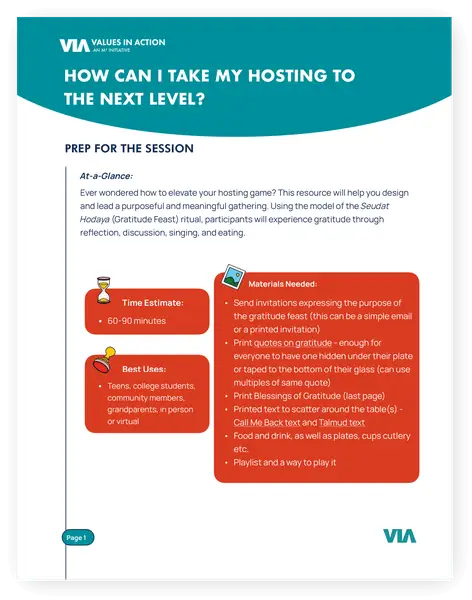
At-a-Glance: Ever wondered how to elevate your hosting game? This resource will help you design and lead a purposeful and meaningful gathering. Using the model of the Seudat Hodaya (Gratitude Feast) ritual, participants will experience gratitude through reflection, discussion, singing, and eating.Time Estimate:
- 60-90 minutes
Best Uses:
- Teens, college students, community members, grandparents, in person or virtual
Materials Needed:
- Send invitations expressing the purpose of the gratitude feast (this can be a simple email or a printed invitation)
- Print quotes on gratitude - enough for everyone to have one hidden under their plate or taped to the bottom of their glass (can use multiples of same quote)
- Print Blessings of Gratitude (last page)
- Printed text to scatter around the table(s) - Call Me Back text and Talmud text
- Food and drink, as well as plates, cups cutlery etc.
- Playlist and a way to play it
Let’s get started
Framing THE EVENT
Note to host: Lead this section with anyone else who might be co-hosting with you, or who might be interested in helping you plan and prepare. This will help you figure out the framing for your event. . Within Jewish ritual there is a feast called a Seudat Hodaya (literally “Feast of Thanks” or a Gratitude Feast). As opposed to the American Thanksgiving or Jewish holidays, it does not take place on a specific day on the calendar, but rather is an organic framework for one to give thanks from something specific.- There are no specific rituals related to it, but it is customary to share words of Jewish wisdom, to sing, and of course eat, drink, and be merry.
- To help decide what we would you want to throw a Gratitude Feast in honor of, let us watch this clip of a Carvel advertisement from the 90s about celebrating the small things
To design our gratitude feast, let us consider the following:
- Are you feeling moved to celebrate one of the “little things” or something momentous at your gathering?
- What specifically are you thankful for? How do you want to express your thanks?
- Who will be invited to celebrate with you?
- What food will be served?
- What will be on the playlist?
- Read these quotes on gratitude, and decide if you want to share these at your event. Are there any additional words of gratitude or wisdom you want to share?
At the Event
At the event: A Gratitude exploration
Welcome everyone! We are so glad you could join us today. We have gathered together for a celebration of gratitude. But what is gratitude? We are going to explore that together. I encourage eating and drinking throughout. We will pause every once in a while to study, reflect, and share gratitude.Once everyone has arrived and is settled, host(s) prompt guests:- Under your plate is a quote about gratitude! I would love to invite you to find a partner, share your quotes and discuss what the quotes mean to you. What is the message that the quote communicates? Do you agree or disagree? Why?
Going Deeper: Jewish Wisdom and Activity
Now that we have explored some ideas around gratitude I would love to hear from each of you. Each person will have the opportunity to share one word that you connect with “gratitude.” The Seudat Hodaya or "thanksgiving feast" is first mentioned in the Torah in Genesis 21:8, "And the child grew and was weaned, and Abraham made a great feast on the day that Isaac was weaned." In the times of the Holy Temple, the Todah (Thanksgiving) sacrifice was an opportunity for a thankful individual to express gratitude to G‑d for His benevolence—specifically for delivery from a dangerous situation. Today, people can host a Seudat Hodaya to show gratitude for rites of passage, recovery from illness or injury, or to just have an opportunity to gather and share our thanks.Host prompts group:- Can you think of a time when you went through something difficult and decided to celebrate after it? What was that like?
- How if at all is it different to express gratitude for big things as compared to small things?
Text A - talmud brachot 58a
Ben Zoma once saw a multitude of people while standing on a stair on the Temple Mount. He immediately recited: Blessed are you Who knows all secrets and Blessed are you Who created all these to serve me. Explaining his custom (and what he meant by all who serve me), he would say: How much effort did Adam the first man exert before he found bread to eat: He plowed, sowed, reaped, sheaved, threshed, winnowed in the wind, separated the grain from the chaff, ground the grain into flour, sifted, kneaded, and baked and only thereafter he ate. And I, on the other hand, wake up and find all of these prepared for me. Human society employs a division of labor, and each individual benefits from the service of the entire world. Similarly, how much effort did Adam the first man exert before he found a garment to wear? He sheared, laundered, combed, spun and wove, and only thereafter he found a garment to wear. And I, on the other hand, wake up and find all of these prepared for me. Members of all nations, merchants and craftsmen, diligently come to the entrance of my home, and I wake up and find all of these before me.Host prompts group:- What is this text communicating?
- What is something that you usually take for granted that you would like to express gratitude for?
- What or who enabled you to be here today, sitting together and eating this food? What or who enabled us to have the food in front of us?
Text b - Rachel goldberg, mother of hersh goldberg-polin
“Well, Dayanu means it would have been enough for us. I think it's 14 verses of explaining what steps were taken in order to be redeemed. And along the way, we keep saying, if God had only done this, it would have been enough. If God had only done. Now, the truth is, I don't know that we mean that. We don't mean if you had just brought us to the tip of the Red Sea, but you hadn't opened it up, it would have been enough. I actually think that would have been a big bummer. But what we're trying to say, I think the whole point of the Haggadah is actually, it's this gratitude training workshop. And sometimes in life, we have to be able to stop, even when we haven't won the whole lottery. And we have to be able to say, I am blessed, I am blessed right here. And that I think is the message of Dayenu, is we have to be able to stop and acknowledge that maybe we don't have it all, but what we have is a blessing.” - From Call Me Back - with Dan Senor: The Paradox of Passover 2025 - with Rachel Goldberg, April 7, 2025 https://youtu.be/6jAEqKiAmuI?si=qji-5c2UbAaGCWm5 Host prompts group:- What was a time when you did not have it all - or were even in a bad situation - when you were able to reframe what you had as a blessing?
- Where in your life might this perspective be welcome?
Blessings of gratitude
nvite everyone to write a blessing of gratitude. They can use any or all of the following prompts for help: May I take the time to pause and express gratitude for _____. I have gone through _____ and been supported by ______. May I remember that ______ has made it possible to _____. Even though it is hard to ______, may I remember to _____. May I remember to send gratitude inward to myself, to show myself compassion for ______. Even though I have not yet _____, may I remember that I have ______ and _____. I will continue hoping for _____ and dreaming for _____. Ask if anyone would like to share one of their blessings with the group.To close, turn to the person next to you, and take a moment to thank them. You can thank them for being here, for listening, or for something specific you appreciate about them. Note: Based on how well the group knows each other, everyone can share aloud with the full group, or each pair can speak privately. End with a blessing that you hope you will all keep noticing what we are thankful for in the days ahead.https://podcasts.apple.com/il/podcast/the-paradox-of-passover-2025-with-rachel-goldberg-polin/id1539292794?i=1000702442883 Share