Gratitude
Seeing Miracles & Blessings of Thanks
Download Resource
What is the connection between
Hanukkah, candles, miracles and blessings?
Hanukkah: Lights, Miracles & Blessings
What is the connection between
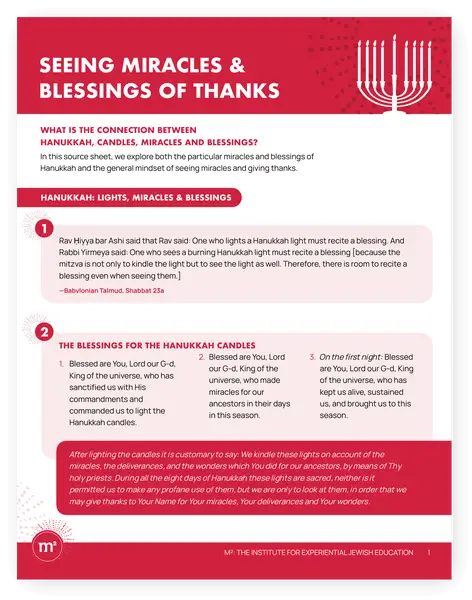
Hanukkah, candles, miracles and blessings? In this source sheet, we explore both the particular miracles and blessings of Hanukkah and the general mindset of seeing miracles and giving thanks.[1] Rav Ḥiyya bar Ashi said that Rav said: One who lights a Hanukkah light must recite a blessing. And Rabbi Yirmeya said: One who sees a burning Hanukkah light must recite a blessing [because the mitzva is not only to kindle the light but to see the light as well. Therefore, there is room to recite a blessing even when seeing them.] —Babylonian Talmud, Shabbat 23a
[2] The Blessings for the Hanukkah Candles
- Blessed are You, Lord our G-d, King of the universe, who has sanctified us with His commandments and commanded us to light the Hanukkah candles.
- Blessed are You, Lord our G-d, King of the universe, who made miracles for our ancestors in their days in this season.
- On the first night: Blessed are You, Lord our G-d, King of the universe, who has kept us alive, sustained us, and brought us to this season.
[3] Additional Prayer for Hanukkah
[We thank You] for the miracles, for the redemption, for the mighty deeds, for the deliverances, for the wonders, for the consolations, and for the wars that You performed for our ancestors in those days at this season.The main commandment of the holiday of Hanukkah is to light (and see) candles, and those candles are accompanied by blessings which are meant to recognize the miracles of Hanukkah and connect them to our current day.- What is the connection between the light of the candle and the miracles of Hanukkah
- Consider the two prongs of the action of this mitzvah: lighting a candle accompanied by a blessing. What does each element represent? What would we be missing if we had one without the other?
- Why do we need two (or three, on the first night) separate blessings? What unique contribution does each one add?
The Power of Blessings
These blessings are part of a larger concept of blessings in Judaism.
Let’s explore the notion of blessings as a vehicle for both recognition and giving of thanks.[1] One that sees a place where miracles were done for Israel should say, “Blessed [is the One] who did miracles for our ancestors in this place.” … On comets, and on earthquakes, and on lightning, and on thunder, and on storms say, “Blessed [be the One] Whose strength and might fill the world.” On mountains, and on hills, and on seas, and on rivers, and on deserts say, “Blessed [is the One] Who makes the works of the creation (bereshit).” R’ Yehuda says: One who sees the great sea says, “Blessed [is the One] Who made the great sea,” only if he sees it occasionally.
On rain and on good news say, “Blessed is the One Who is good and does good.”
And on bad news say, “Blessed [are You] the true Judge.”When one builds a new house and acquires new vessels, they say, “Blessed [is the One] Who has kept us alive [and sustained us and brought us to this time].”
A person is obligated to bless upon the bad just as they bless upon the good. —Mishnah Berakhot 9:1-5[2] Rav Yehuda said that Rav said: Four must offer thanks to G-d with a thanks-offering and a special blessing. They are: seafarers, those who walk in the desert, and one who was ill and recovered, and one who was incarcerated in prison and went out
… What blessing does he recite? Rav Yehuda said: Blessed is … Who bestows acts of loving-kindness —Babylonian Talmud, Menachot 43b[3] Rabbi Meir said: A person must make 100 blessings each day, as it is written … "And now Israel, what does the Lord your G-d ask of you..." (Deuteronomy 10:12) —Babylonian Talm —Mishnah Berakhot 9:1-5
- What are the different types of scenarios mentioned in which one is expected to say a blessing?
- Are blessings made only for supernatural occurrences or miracles?
- Which blessings especially resonated with you? Are there ones mentioned that you would consider incorporating into your practice?
- Are there additional elements or people which you would like to express gratitude towards?
- What value is there in making 100 blessings every day? What might we learn from being in the habit of saying many blessings a day?
Contemporary Voices
[1] The sense for the “miracles which are daily with us,” the sense for the “continual marvels,” is the source of prayer. There is no worship, no music, no love, if we take for granted the blessings or defeats of living. No routine of the social, physical, or physiological order must dull our sense of surprise at the fact that there is a social, a physical, or a physiological order. We are trained in maintaining our sense of wonder by uttering a prayer before the enjoyment of food. Each time we are about to drink a glass of water, we remind ourselves of the eternal mystery of creation, “Blessed be Thou…by Whose word all things come into being.” A trivial act and a reference to the supreme miracle. Wishing to eat bread or fruit, to enjoy a pleasant fragrance or a cup of wine; on tasting fruit in season for the first time; on seeing a rainbow, or the ocean; or noticing trees when they blossom; on meeting a sage in Torah or in secular learning; on hearing good or bad tidings — we are taught to invoke His great name and our awareness of Him. Even on performing a physiological function, we say “Blessed be Thou … who healest all flesh and doest wonders.”This is one of the goals of the Jewish way of living: to experience commonplace deeds as spiritual adventures, to feel the hidden love and wisdom in all things. —Abraham Joshua Heschel, G-d In Search of Man, p.49[2] In considering the miracle of the cruse of oil, our Rabbis asked why the holiday of Hanukkah was celebrated for eight days rather than for seven days. Since there was, by all accounts, sufficient oil for one day, only seven of the eight days of burning may be designated as miraculous days. Though several ingenious explanations were offered, what strikes me as being the miraculous feature of the initial day was the community's willingness to light the lamp in spite of the fact that its anticipated period of burning was short-lived. The miracle of the first day was expressed in the community's willingness to light a small cruse of oil without reasonable assurance that their efforts would be sufficient to complete the rededication of the Temple. Hanukkah celebrates the miracle expressed by those who lit the lamp and not only the miracle of the lamp's continued burning for eight days. —Rabbi David Hartman, Trusting in a New Beginning in A Different Light[3] A simple Hebrew blessing is a powerful thing — a oneminute, deeply meditative exercise exploring the nature of the Creative Force we call G-d and the dynamic relationship between G-d, human consciousness, and the unfolding universe. Far from a mindless mumble, each word of a Hebrew blessing is crafted to touch deep centers of awareness and receptivity within us. Each word is a stepping-stone inviting us to explore a rich treasury of images and associations.Blessing offers us a personal consciousness-raising practice, a spiritual adventure bringing sensitivity and gratitude into the foreground of our lives. While we have moments when a blessing rises spontaneously to our lips, the path of blessing can become a way of life.
Through the practice of blessing, we develop an everdeepening receptivity to the abundant love and joy flowing through Creation. We learn to accept that love, absorb it into our souls, and offer it back to the source with joy. In this way, we come to feel the Presence of G-d move within us and through us. The result is bliss. —Rabbi Marcia Prager, The Path of Blessing: Experiencing the Energy and Abundance of the Divine[4] Jewish prayer is an ongoing seminar in gratitude. Birkot haShachar (The Morning Blessings), ‘the Dawn Blessings’ said at the start of morning prayers each day, form a litany of thanksgiving for life itself: for the human body, the physical world, land to stand on, and eyes to see with. The first words we say each morning — Modeh/Modah ani, “I thank you” — mean that we begin each day by giving thanks.Gratitude also lies behind a fascinating feature of the Amida. When the leader of prayer repeats the Amida aloud, we are silent other than for the responses of Kedushah, and saying Amen after each blessing, with one exception. When the leader says the words Modim anachnu lach, “We give thanks to You,” the congregation says the parallel passage known as Modim deRabbanan. For every other blessing of the Amida, it is sufficient to assent to the words of the leader by saying Amen. The one exception is Modim, “We give thanks.” Rabbi Elijah Spira (1660–1712) in his work Eliyahu Rabbah explains that when it comes to saying thank you, we cannot delegate this away to someone else to do it on our behalf. Thanks has to come directly from us.Part of the essence of gratitude is that it recognizes that we are not the sole authors of what is good in our lives. The egoist, says Andre Comte-Sponville, “is ungrateful because he doesn’t like to acknowledge his debt to others and gratitude is this acknowledgement.” La Rochefoucald put it more bluntly: “Pride refuses to owe, self-love to pay.” Thankfulness has an inner connection with humility. It recognizes that what we are and what we have is due to others, and above all to G-d. Comte-Sponville adds: “Those who are incapable of gratitude live in vain; they can never be satisfied, fulfilled, or happy; They do not live, they get ready to live, as Seneca puts it.” —Former Chief Rabbi Lord Jonathan Sacks, https://www.ou.org/torah/parsha/rabbi-sacks-on-parsha/the-power-of-gratitude/
- What qualities or actions are required to notice and recognize miracles?
- What mindset might be formed by someone who regularly gives blessings or thanks?
- What forms of expressing gratitude do you incorporate into your life?
Share